Last updated: August 31, 2026
New Orleans Electrical Services connects homeowners and businesses with licensed electrical contractors serving New Orleans and Orleans Parish with 24-hour emergency response. An emergency electrician in New Orleans is what you need when the problem is actively unsafe rather than merely inconvenient: a burning smell, a hot or discolored outlet, visible arcing, a panel that hums or ticks, or a service drop torn loose by wind. Those are not next-week problems. The line is answered by a person at any hour, and if the situation is dangerous we will tell you what to shut off before we are on the road.
What we do on the first visit
Every emergency electrician job starts the same way: we look before we quote. You get the cause in writing, a price that does not move once work begins, and the permit filed by us rather than by you.
- You call, a person answers. No hold queue, no callback form. We ask what you can see and smell, and whether anyone is in the building.
- Make safe over the phone. If the hazard is live we walk you through shutting down the affected circuit or the main before we leave the shop.
- Diagnose the actual fault. We find the cause, not the symptom. A tripping breaker is a signal; the fault is upstream of it.
- Stabilize, then quote the permanent fix. We make the situation safe first. The permanent repair is priced in writing before we do it, not after.
What counts as an electrical emergency in a New Orleans home
The honest test is whether the condition can start a fire or shock someone before morning. A burning smell with no visible source is the clearest case: overheating conductors give off a distinct hot-plastic or fishy odour from the insulation breaking down, and the smell arrives well before there is anything to see. So is any warmth in a faceplate, any discoloration around a receptacle slot, and any breaker that will not hold after one reset.
Two failure modes are specific to housing stock here. In pre-1950s shotguns and Creole cottages still carrying knob-and-tube or cloth-insulated conductor, the insulation embrittles with age and then fails at a mechanical stress point, usually where a wire passes a joist or enters a box. In homes wired with aluminum branch circuits during the 1960s and 1970s, the failure happens at the terminations: aluminum expands and contracts more than copper, the screw connection works loose over decades, resistance climbs, and the connection heats. Both present the same way to a homeowner, which is why a warm switch plate in an older house is worth a call rather than a wait.
What is not an emergency: a single dead outlet with no smell and no heat, a light fixture that has stopped working, or a breaker that tripped once during a storm and has held since. Those are real problems and we will book them, but they do not need a 2 a.m. truck and we will say so on the phone rather than sell you one.
Storm and outage calls: what we can and cannot do
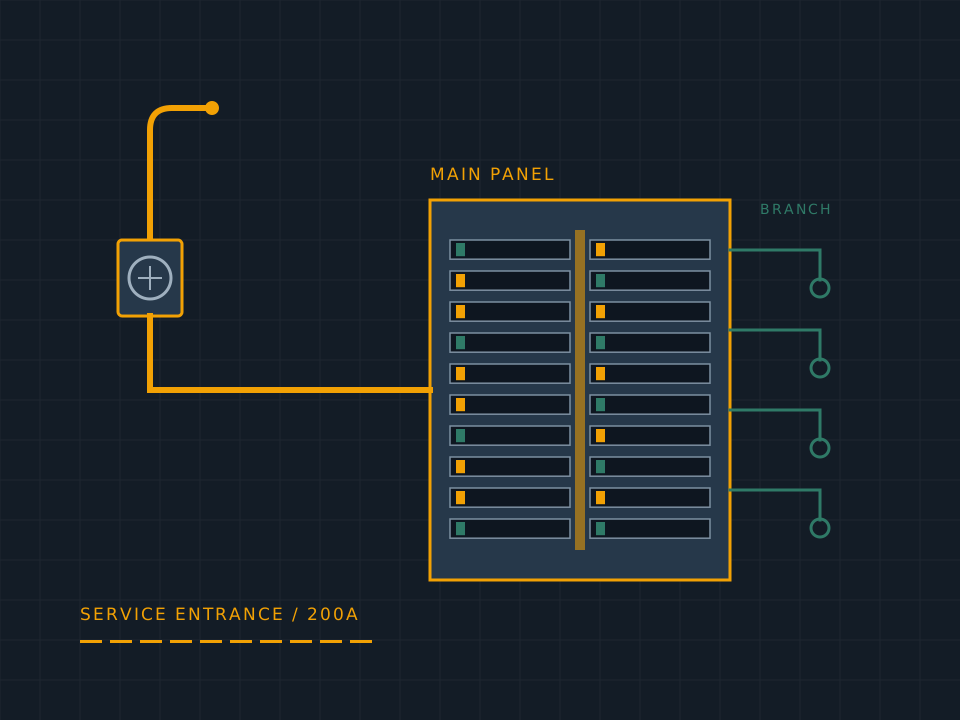
After a named storm the line between a utility problem and a homeowner problem matters, because it decides who can legally touch it. Everything from the transformer to the weatherhead belongs to Entergy. Everything from the weatherhead inward, including the service entrance conductors, the meter can, the mast and the panel, is the property owner's and is ours to repair.
In practice the common post-storm job is a service mast bent or torn by a falling limb. Entergy will not reconnect the drop until the mast and meter can are repaired and, in Orleans Parish, until the repair has been inspected. That sequence is the whole reason these calls take days rather than hours, and it is worth understanding before you are in it: we repair and call for inspection, the parish inspects, and Entergy reconnects. We file the inspection request the same day the repair is complete.
Hurricane Ida is the scale reference everyone here already has. At its peak the storm produced 948,000 Entergy outages, and all eight transmission lines feeding greater New Orleans went out of service, disconnecting the city from the bulk grid. Restoration ran into the billions. That is the event a standby generator and a properly bonded, surge-protected service are actually sized against.
What to do before we arrive
If you smell burning and can identify the room, switch off that circuit at the panel. If you cannot identify it, or the smell is at the panel itself, shut off the main and leave it off. A panel that is arcing internally is the one case where we would rather you did not open the cover at all.
Do not reset a breaker more than once. A breaker is a sacrificial safety device and repeated resets against a live fault degrade the mechanism, which is how a breaker ends up failing to trip when it matters. Do not run extension cords from a working circuit to replace a dead one; that is how an inconvenience becomes an overload.
If there is water involved, treat everything as live until the main is off. Standing water in a raised-basement or under-house space with junction boxes in it is a genuine electrocution risk, and after a flood event it is the single most common way people are hurt during cleanup rather than during the storm.
What is included
- Live answer, 24 hours a day, by a person rather than a phone tree
- Phone triage before dispatch, including what to shut off right now
- Arrival window given on the call, and an update if it changes
- Thermal and voltage diagnosis at the panel and the affected circuits
- Immediate make-safe: isolate, lock out, and stabilize the hazard
- Written cause and scope before any repair work begins
- Temporary safe power restoration where the permanent fix needs parts
- Entergy coordination when the fault is on the service side
What you should expect to pay
HomeYou New Orleans electrical repair cost data (161 completed local projects, average $94-$125) cross-checked against 2026 national service-call fees of $79-$179.
| Job | Range |
|---|---|
| Diagnostic / service call | $95 - $145 |
Emergency dispatch carries the same diagnostic fee as a scheduled call. There is no separate after-hours surcharge on the diagnostic itself; overtime labor, if the repair runs long, is quoted before we start.
Run the cost estimator for a range against your own situation, or call 504-336-6748 and describe the job.