Last updated: August 31, 2026
New Orleans Electrical Services connects homeowners and businesses with licensed electrical contractors who install permanently mounted standby generators across New Orleans and Orleans Parish. Whole house generator installation in New Orleans is a multi-trade job: an electrical scope, a fuel-gas scope, a concrete or composite pad, a permit, and an Entergy notification. The generator itself is often less than half the installed cost, which is why a quote that names only a model number is not a quote.
What we do on the first visit
Every standby generator installation job starts the same way: we look before we quote. You get the cause in writing, a price that does not move once work begins, and the permit filed by us rather than by you.
- Load study first. We measure and calculate what you actually need to run, then decide whole-house or managed essential loads.
- Site the unit and the fuel. Clearances, flood elevation, gas line capacity or propane tank placement, and the trench route to the panel.
- Install and interconnect. Pad, unit, transfer switch, and the panel work. Permit and Entergy notification handled on our side.
- Commission under load. We kill the utility feed and prove the transfer works with your real load on it, then walk you through it.
Sizing: whole-house is not always the right answer
The instinct is to buy a generator that runs everything. It is frequently the wrong purchase. The alternative is a smaller unit paired with a load-management system that automatically sheds non-essential loads, typically the electric water heater, the dryer, and one HVAC zone, whenever total demand would exceed the generator's capacity.
Load shedding lets a materially cheaper unit carry a larger house for most of an outage, at the cost of intermittent operation for the managed loads. In a Gulf Coast summer the decision usually comes down to air conditioning: a three-ton condenser has a starting inrush several times its running current, and a generator sized only on running watts will stall trying to start it. Two condensers, which a lot of converted-attic houses here have, roughly doubles the problem.
So the sizing conversation is really about which August afternoon you are buying. Running the whole house including both AC systems is one number. Running one AC zone, the refrigerator, the kitchen, lights, internet and the sump is a much smaller and much cheaper number, and for most families it is the honest answer.
The transfer switch is the part that matters
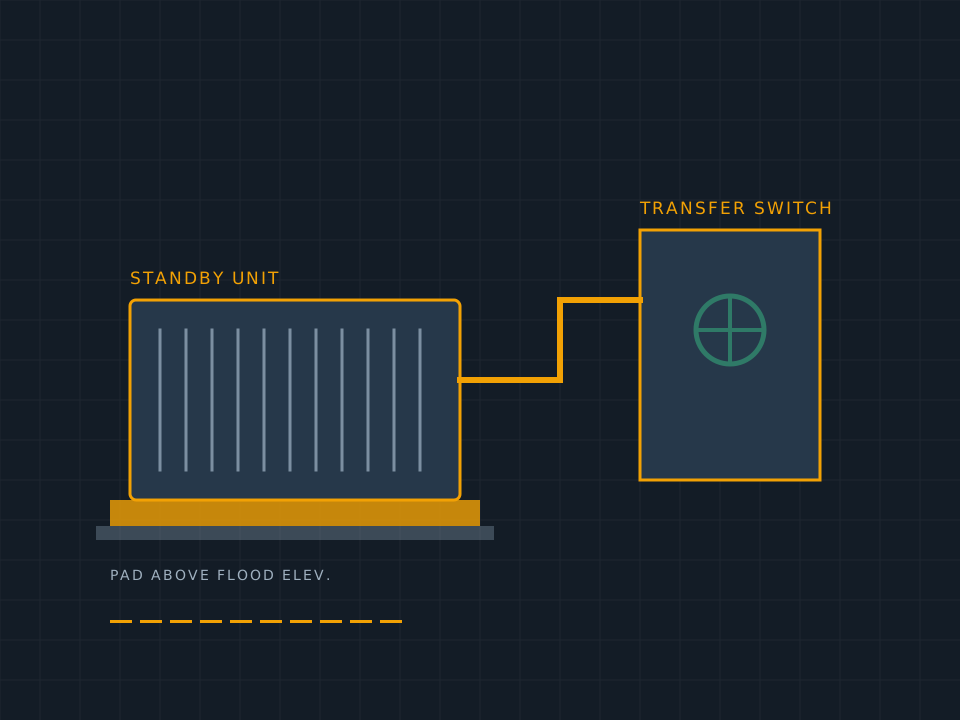
An automatic transfer switch senses the loss of utility power, signals the generator to start, waits for the engine to come up to speed, and only then transfers your panel from the utility feed to the generator output. When utility power returns it transfers back and runs the engine through a cooldown. You do nothing.
The safety function is the important one: the switch makes it physically impossible for the generator to be connected to the utility at the same time. Backfeeding a de-energized Entergy line through a suicide cord or an improvised connection puts lethal voltage onto conductors that line crews are working on, and it is the single most dangerous thing people do with generators after a storm. A permitted install with a listed transfer switch removes that risk entirely.
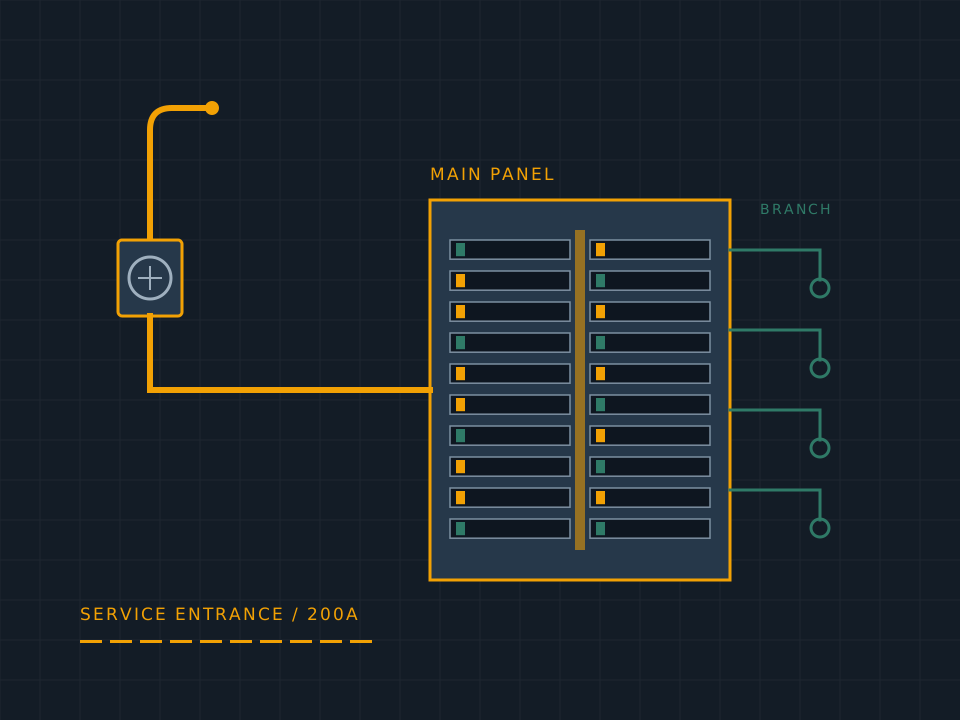
Two decisions get made here. A service-rated transfer switch sits ahead of the panel and covers the whole service; a subpanel arrangement backs up a chosen set of circuits. And the switch has to be sized to the service, which is why an undersized or corroded existing panel frequently turns into part of the generator scope rather than a separate project.
Flood elevation, fuel, and the things specific to here
Siting a generator in this metro has constraints that do not come up in most of the country. The pad has to sit above your flood elevation, which in much of Orleans and Jefferson Parish means raising it deliberately rather than setting it on grade. It also has to hold manufacturer clearances from windows, doors, vents and the property line, which on a narrow shotgun lot with a side alley is often the binding constraint rather than the flood elevation.
Fuel choice follows availability. Natural gas is the preferred supply where the street has it, because there is no tank to site and no refilling to plan, but the existing gas line frequently cannot carry the additional demand and has to be upsized from the meter. Propane means a tank, which means a location that satisfies both setback rules and flood elevation, plus a pre-season refill plan. Neither is automatically better; the site decides.
The scale reference for why any of this is worth doing is recent. Hurricane Ida produced 948,000 Entergy outages at peak and took all eight transmission lines feeding greater New Orleans out of service, disconnecting the city from the bulk grid. A standby system is sized against multi-day outages of that kind, not against a two-hour flicker.
What is included
- Load study to decide whole-house versus managed essential loads
- Generator sizing against the calculated load, not the square footage
- Automatic transfer switch specified, supplied and installed
- Pad siting checked against NEC and manufacturer clearances
- Fuel supply coordinated: natural gas line sizing or propane tank siting
- Load-shed management where a smaller unit can cover a larger home
- Permit filed and Entergy notified of the interconnection
- Commissioning, transfer test under load, and owner walkthrough
What you should expect to pay
We do not publish a headline generator price, because any number that ignores fuel type, tank siting, trenching distance, pad work, transfer switch type and the condition of your existing panel is a number you will not end up paying. What we do publish are the components that make up the total, below, and the sourced ranges for the electrical work that goes with it.
| Component we can publish | Range |
|---|---|
| 100A to 200A service upgrade | $2,000 - $4,500 |
| Electrical permit | $50 - $300 |
| Subpanel installation | $400 - $2,000 |