Last updated: August 31, 2026
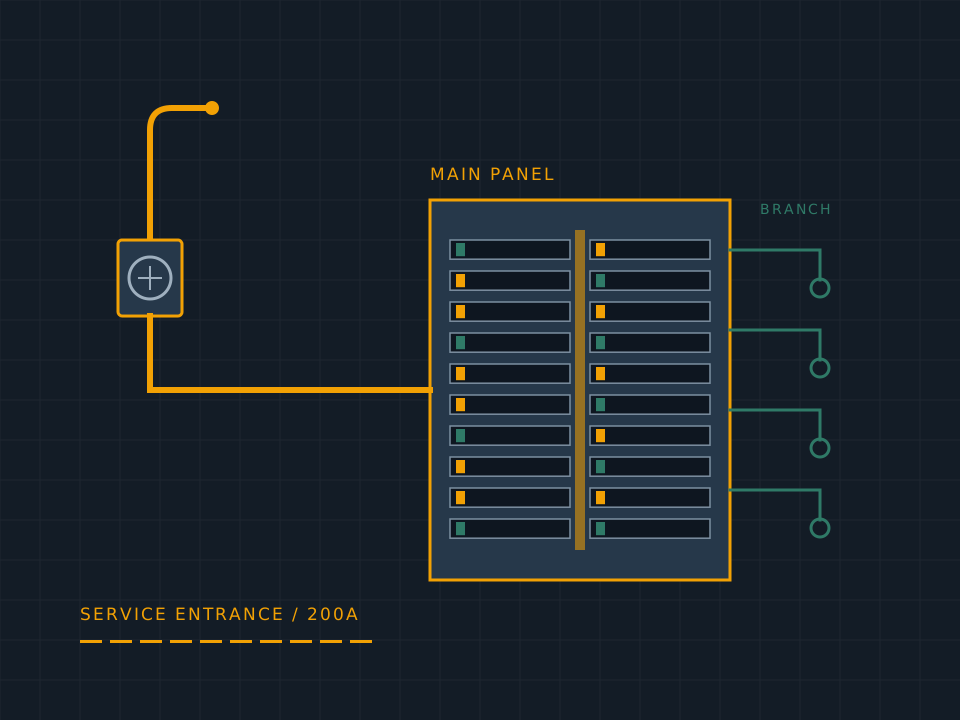
New Orleans Electrical Services connects homeowners and businesses with licensed electrical contractors who replace and upgrade service panels across New Orleans and Orleans Parish. An electrical panel upgrade in New Orleans usually means one of two jobs: swapping a failing or obsolete panel for a modern one at the same amperage, or raising the service itself, most often from a 100-amp panel or a screw-in fuse box to 200-amp. The second job is the one that needs Entergy coordination and a parish inspection, and it is the one worth understanding before you take bids.
What we do on the first visit
Every electrical panel upgrade job starts the same way: we look before we quote. You get the cause in writing, a price that does not move once work begins, and the permit filed by us rather than by you.
- Load calculation, not a guess. We total the actual connected load under NEC 220 and size the service to it, allowing for what you plan to add.
- Permit and utility scheduling. We file with the parish and book the Entergy disconnect. This is the step that sets your date, so we do it first.
- Changeover day. Power off, old panel out, new panel and grounding in, circuits landed and labelled. Most jobs are one day.
- Inspection and reconnect. The parish inspects, Entergy reconnects, and you get the permit and sign-off for your file.
Why so many New Orleans panels are undersized rather than broken
A 100-amp service was a generous allowance for a house built in 1955 with one window unit, no dryer and a gas range. The same house today runs central air through a Gulf Coast summer, an electric dryer, a dishwasher, a microwave, and frequently a second AC system for a converted attic. Nothing about the panel has failed. It is simply being asked for more than it was sized for, and the symptom is a breaker that trips on hot afternoons rather than a dramatic fault.
This is why the load calculation matters more than the amperage on the sticker. Under NEC Article 220 the calculation accounts for general lighting load by square footage, small-appliance and laundry circuits, the largest of heating or cooling, and then applies demand factors to the rest. A 1,600 square foot uptown double with two three-ton condensers and an electric range does not need the same service as a 1,600 square foot Lakeview ranch on gas heat, and any contractor who quotes 200 amps without asking what is in the house is quoting a part number, not a design.
The practical consequence for you is that a 200-amp upgrade is not automatically the right answer. Sometimes the correct fix is a subpanel for a specific load at $400 to $2,000, or a single dedicated circuit, and we will say so.
Federal Pacific, Zinsco, and panels that are a problem on their own
Two panel families come up constantly in housing of this vintage and both are replacement candidates regardless of capacity. Federal Pacific Stab-Lok panels have a documented history of breakers that fail to trip on an overload, which defeats the single thing a breaker exists to do. Zinsco and Sylvania-Zinsco panels suffer from bus bar deterioration where the breaker clips onto the bus, producing heat at the connection and, eventually, breakers welded to the bus.
Neither is a code violation on its own, which surprises people. Existing installations are generally allowed to remain. What happens instead is practical: home inspectors flag them at sale, some insurers will not write or renew a policy over them, and replacement breakers are either unavailable or aftermarket. If you have one, you will eventually replace it, and doing it on your schedule costs less than doing it during a sale.
Humidity here adds a third category worth checking: any panel with visible rust on the interior, corrosion on the bus, or white oxidation on aluminum service conductors. Corroded connections are resistive connections, resistive connections heat, and a panel enclosure in a damp under-house space or on a coastal-exposed exterior wall corrodes faster than the same panel would in a dry climate.
The Entergy step nobody mentions in a bid
Raising your service amperage means the utility has to disconnect the drop, and that is a scheduled event, not something the electrician does. The order of operations is fixed: permit filed, Entergy disconnect booked, work performed, parish inspection passed, Entergy reconnect. Skip or reorder any of it and you sit without power waiting for someone else's calendar.
Ask any bidder how they handle that scheduling. A bid that is $400 cheaper because the contractor expects you to call the utility yourself is not cheaper. A bid that does not mention the permit at all is a bid to do unpermitted work on your service entrance, which is both the most heavily inspected part of a residential system and the part your insurer is most likely to ask about after a fire.
We file the permit, book the disconnect, and meet the inspector. The permit number and the signed-off inspection record go to you when the job closes.
What is included
- NEC Article 220 load calculation completed before anything is ordered
- Permit filed with Orleans Parish Safety and Permits
- Entergy disconnect and reconnect scheduled and coordinated
- New panel, breakers, and labelled circuit directory
- Grounding electrode system brought to NEC Article 250
- Water and gas piping bonded per code
- AFCI and GFCI protection placed per NEC 210.12 and 210.8
- Inspection scheduled, attended, and signed off
What you should expect to pay
Published New Orleans contractor pricing for a fuse box or 100A panel upgraded to 200A service, which runs above the $1,800-$3,500 national band because of Entergy service-drop coordination and Orleans Parish permitting.
| Job | Range |
|---|---|
| 100A to 200A service upgrade | $2,000 - $4,500 |
| Panel replacement, same amperage | $1,200 - $2,400 |
| Subpanel installation | $400 - $2,000 |
| Electrical permit | $50 - $300 |
Panel relocation adds $800 to $4,000 depending on the new location and the wall it comes out of. If the service mast, meter can or grounding electrode system also needs replacing, that is separate and we itemize it.
Run the cost estimator for a range against your own situation, or call 504-336-6748 and describe the job.